
Port Arthur City Directory Holdings
Port Arthur city directory research begins with overlapping shelves, not a single complete run. The Marion & Ed Hughes Public Library Archive Room in Nederland publishes the most detailed local list. It holds printed Port Arthur volumes from 1925 through 2006, with gaps. The University of Texas citation database independently identifies Worley’s Port Arthur and Vicinity City Directory from 1921 through 1958, while Southwestern Bell issues supply a separate telephone layer. Each collection has a different geographic subtitle and access route, so record the exact edition before drawing a conclusion.
| Collection | Years | Where held | Access route |
|---|---|---|---|
| Hughes Port Arthur directory shelf | 1925-2006, with gaps | Hughes Archive Room, Nederland | Physical local-history holdings |
| Worley Port Arthur and Vicinity volumes | 1921, 1923, 1931, 1957, 1958 metadata within a 1921-1958 run | University of Texas citation database | Use the citation to request the issue or scan |
| Southwestern Bell directories | 1924-1998 listed issues | University of Texas metadata and library routes | Telephone-subscriber evidence, not every resident |
| Port Arthur News obituary index | 1969-2026 | Port Arthur Public Library | Public finding aid, then newspaper access as available |
The Hughes sequence is especially dense from the postwar years through the late twentieth century, but it is not annual. A missing name can reflect an absent edition, a publisher convention, an unlisted household, or a move. It is not enough to treat an unsearched gap as proof of an event.
Note: Check that an edition exists and that its relevant section was searched before treating a missing listing as a household move.
Port Arthur Directory Shelves in Nederland
The Hughes Archive Room makes the printed record practical. Its list includes early 1925, 1927, 1929, 1931 and 1933 volumes; wartime-era holdings with gaps; repeated postwar editions; and later volumes through 2006. The room is at 2712 Nederland Avenue, Nederland, and posts hours of Monday and Thursday 10-7, Tuesday, Wednesday and Friday 10-6, and Saturday 10:30-2. Call 409-722-1255 before a research trip, particularly when a single edition or an address section is essential.
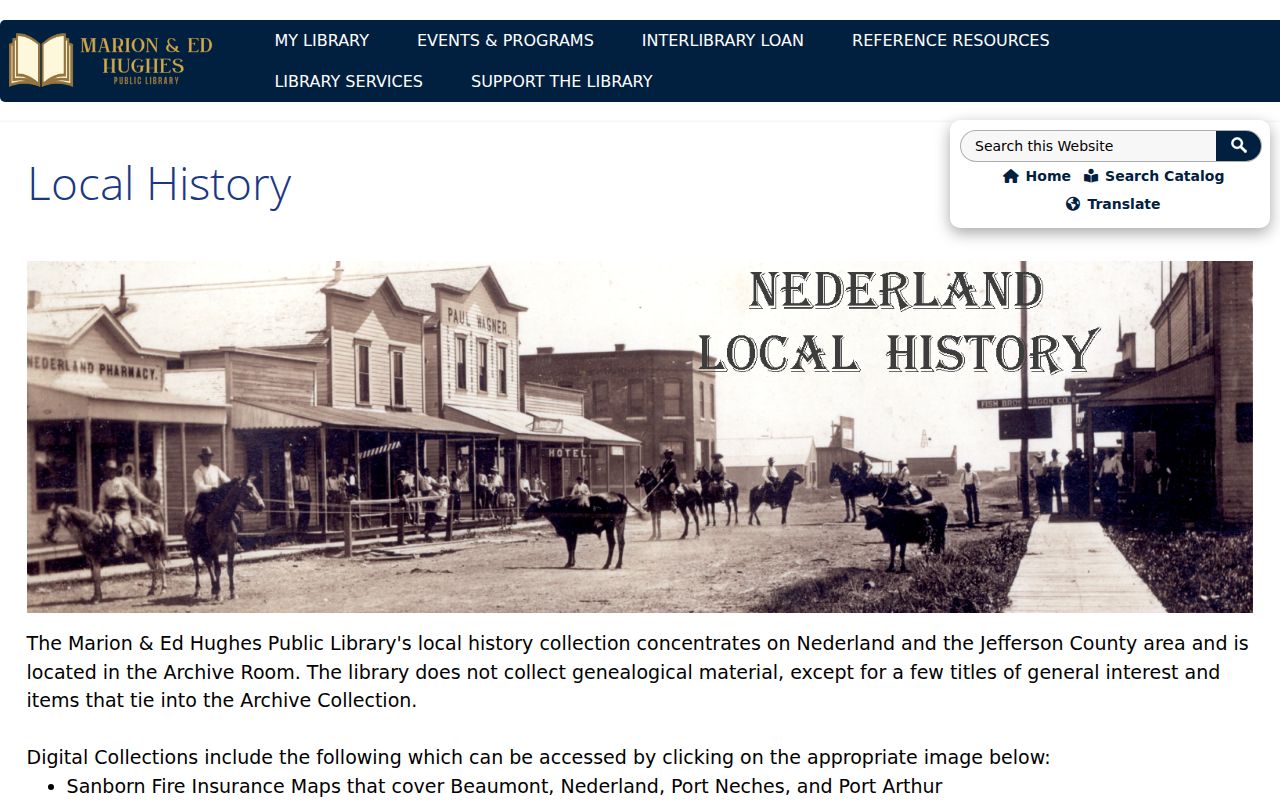
Hughes Library’s local-history page shows the Archive Room’s directory holdings and related historical material.
The shelf list is a starting inventory. Ask for the edition, its title page, and the alphabetical or street section needed, rather than asking staff to infer a household from an incomplete address.
Hughes also notes that Nederland has no separate city directory and is included in Port Arthur or Beaumont directories. That makes the volume’s stated coverage more useful than a modern municipal label. A search for a nearby family should include the subtitle, place names, and the surrounding-town scope printed in the book.
Port Arthur Vicinity Directory Volumes
Worley metadata describes the volumes as Port Arthur and Vicinity, not merely Port Arthur. The cited geography includes Griffing Park, Groves, Lakeview, Nederland, Pear Ridge, Port Acres, Port Neches, Sabine, and Sabine Pass. Those labels are useful search terms because a directory entry may use a neighborhood or community name that does not match a later map label. Port Arthur’s growth around the port, refining, rail connections, and changing boundaries helps explain why a family could appear under more than one local description.
The University of Texas directory citation identifies the Worley run and its selected years. Capture publisher, year, geographic subtitle, page, spelling, and the nearby entries when using any cited volume.
The Portal to Texas History collection for Port Arthur Public Library provides browseable local material with title, date, type, and creator metadata.
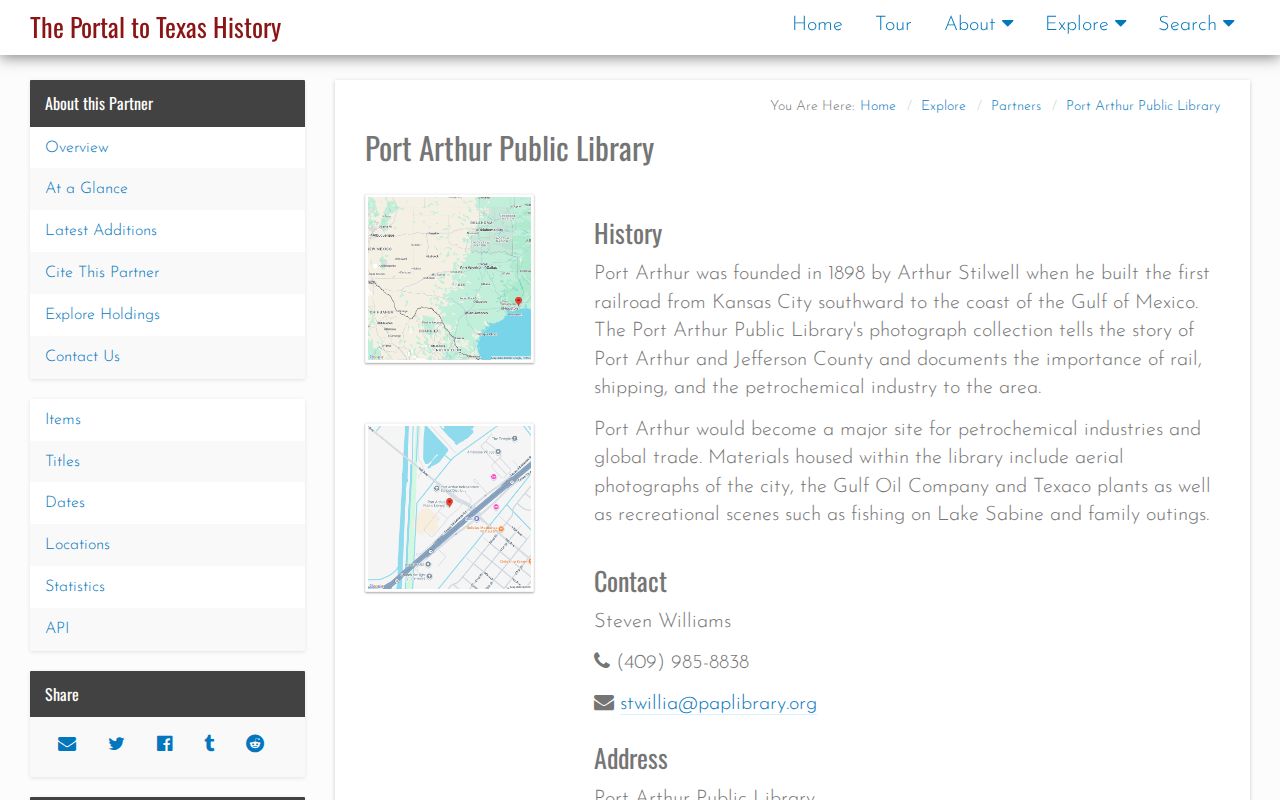
The portal includes photographs, yearbooks, text, and World War I material. It can add context to a directory find, but an item image does not replace a directory page or establish a person’s identity by itself.
Reading Port Arthur City Directory Lines
A Port Arthur city directory line is usually a surname- or address-keyed listing. It may show the surname, given name or initials, a street address, and sometimes an occupation, business, spouse indicator, or telephone number. The exact abbreviation key changes by publisher and year. No high-resolution Worley page and printed key were available in the research capture, so an unreadable mark should be checked in the actual scan or bound volume rather than expanded from memory.
| Name as printed | Copy surname, initials, spelling, and any household or spouse marker exactly. |
|---|---|
| Street information | Record house number, street spelling, cross street, and neighborhood label when shown. |
| Role text | Preserve occupation, business category, residence or business indicator only as the edition prints it. |
| Contact detail | Capture a telephone number or other listing detail when the edition includes one. |
| Source detail | Keep title, edition year, publisher, page, and scan or image reference with the transcription. |
- Criss-cross directory
- A reverse section arranged by street or address, used to find listings at a known location when the volume contains one.
- Householder index
- An alphabetical arrangement that may center the household head rather than every person connected with an address.
- Abbreviation key
- The publisher’s explanation of symbols and shortened terms, often near the front of a volume and necessary before interpreting a line.
One listing proves that a name appeared in that edition. It does not prove legal title, current occupancy, or a relationship that the line does not state. For a modern confirmation after an historical lead, use the person-focused records process in the Port Arthur resident lookup.
Note: Read the abbreviation key in the same volume because symbols and wording can vary by publisher and edition year.
Port Arthur Telephone Directory Layer
Telephone books add a second historical layer. University of Texas metadata lists Southwestern Bell issues from June 1924 through December 1998, with many dated editions between those endpoints. The places named in that run include Bridge City, Groves, Nederland, Port Arthur, and Port Neches. Telephone volumes can help connect a surname, an address, and a local calling area across a period where a city directory is missing.
They also have a built-in limit. A telephone directory records a subscriber, not every person at an address, and unlisted numbers or households will not appear. Compare an apparent disappearance with nearby editions, the city-directory run, and independent records before deciding that a household left.
Tracing Port Arthur Directory Households
Family-history work is strongest when each directory year is treated as a dated observation. Start with the surname section, then use the reverse or street section if it is present. Pair each available edition with the county deed index, an obituary lead, a cemetery survey, or census material only when names, addresses, or dates independently line up. Keep “directory listing,” “owner,” “mailing address,” and “occupant” as separate facts.
- Find the first available directory listing and write down the edition, page, exact name, address, and all printed markers.
- Check the preceding and following available Hughes or Worley editions to distinguish a move from a gap in the collection.
- Use the street or criss-cross section, when included, to inspect the same address and adjacent house numbers.
- Search spelling variants, initials, married and maiden names, and household-head conventions in the alphabetical section.
- Pair the year with census, deed, obituary, or cemetery evidence, noting whether each source supports a name, address, date, or relationship.
For older address work, the Port Arthur street directory provides the modern parcel and address-record path. Historical research needs the printed volume, its coverage statement, and the possibility that a street label or vicinity name changed.
Port Arthur Obituary Index Links
The Port Arthur News Obituary Index offers year pages from 1969 through 2026. Its visible rows can include name, age, obituary date, page, and status or notes. Use Ctrl+F on a year page to locate a surname, then preserve the date and page as a lead for a newspaper search. The index is not a certified death record and does not include every person whose notice was never published.
County cemetery surveys can be a useful companion. The Jefferson County Historical Commission material includes Port Arthur-related records for Calvary Catholic Cemetery and Port Arthur Memory Gardens. A surname, marker section, and obituary date can strengthen a family-history trail, while the cemetery operator remains the authority for an interment record.
Note: A cemetery survey can support a place clue, while the cemetery operator remains the source for current interment confirmation.
Port Arthur Directory Archive Routes
When the local shelf does not contain the needed edition, use the access channel that fits the collection. Port Arthur Public Library lists genealogy resources, HeritageQuest, Family Tree Maker CDs, newspaper databases, and some in-library databases. The Port Arthur Public Library genealogy page is a practical first contact at 409-985-8838. Access to a particular database may be remote, in-library, or account controlled, so availability should be checked before relying on it.
Port Arthur Public Library’s genealogy resources provide the local-library entry point for the historical collections discussed here.

The library route is useful for an obituary-index lead, an in-library database, or a referral to another archive when a printed directory edition is not on the local shelf.
The Jefferson County Historical Society catalog covers more than 27,000 records, although most material is cataloged rather than digitized. Save the identifier and contact research@jchsmuseum.com for an appointment or distant-research scan. The Sam Houston Regional Library and Research Center and Texas State Library and Archives Commission add on-site records, microfilm, maps, rare books, and county material. Library loans, reading rooms, and an edition-specific phone request are all documented alternatives to an unavailable web scan.
For a government-held directory inventory, historic permit ledger, or digitization-project record, use the Port Arthur open-records request route or the appropriate county process under the Texas Public Information Act. Library and historical-society holdings can instead follow their own access terms.
Port Arthur City Directory Eras
The directory record has a clear local chronology. Port Arthur was platted in 1895, incorporated in 1898, and its port opened in 1899. The documented vicinity-directory run begins with 1921 and 1923 metadata, the Hughes shelf starts at 1925, and the local printed holdings end at 2006. Telephone-directory metadata extends from 1924 through 1998. These dates describe available research layers, not a continuous list of people.
| 1921 and 1923 | Early Worley vicinity metadata establishes the documented opening of the cited city-directory layer. |
|---|---|
| 1925 | First year in the detailed Hughes Port Arthur shelf inventory. |
| 1969 | First year exposed by the dedicated Port Arthur News obituary-index pages. |
| 2006 | Latest Port Arthur printed-directory year listed by Hughes, without claiming that no later directory exists elsewhere. |
Older records may be on microfilm, in bound county books, or in archive collections. An unsuccessful online search should lead to a library shelf, public terminal, microfilm guide, or targeted archive request, not a claim that the record never existed.